Thursday, 21 June 2018


Saturday, 9 June 2018
Preauricular Sinus
Preauricular Sinus is a common congenital malformation characterised usually by a dimple near the external auditory canal. Most of them are asymptomatic and not treated unless they get repeated infections.

Preauricular Sinus can have some clear or whitish discharge even when it is not infected. In this case , just keep the area clean by washing with soapy warm water.
If there are signs of infection: pain, fever, pus discharge: meet a doctor and antibiotics are needed.
If abscess, then incision and drainage is required.
If a preauricular Sinus is getting infected repeatedly or abscess is drained, then a definitive decision of Sinus is planned in 8–12 weeks.
Monday, 4 June 2018
Does technology distances Doctors from Patients?
Clinicians, inundated with
information in the form of over-stuffed electronic medical records, lab and
imaging results, medical websites, decision trees, algorithms, screening
guidelines, and best practice pathways have a responsibility to carefully
evaluate that information and ask whether it is good, and what can be done with
it, and — most importantly — whether it is applicable to our singular patient
now.
—Dr. Faith
Fitzgerald, “Medicine: The Greatest of Humanities”
To start this discussion, let me say that I believe I am a blessed generation of doctor who was trained in an era when
technology was just entering in medicine. We saw an exponential increase in availability of
technology and dare I say “dependence on
technology” in the last 3 decades.
Healthcare has changed dramatically
because of technological developments, from anesthetics and antibiotics to
magnetic resonance imaging scanners and radiotherapy to new drugs and
treatments, new device, new social media support for healthcare...the list goes
on and on.
So being a clinical bedside physician, we went on
to adapt the various investigations and interventions. However while these changes occurred one thing remained constant “The
Patient” as caretaker and “The doctor” as primary caregiver.
I used to see outpatients something like this...
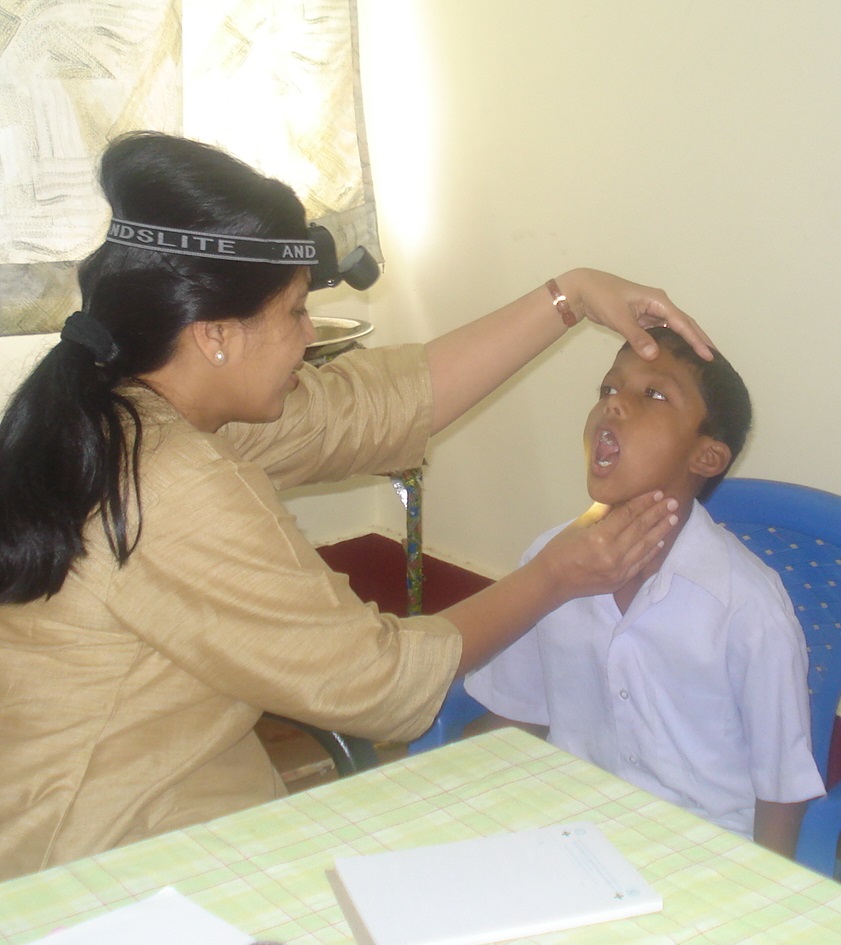
then it was something like this with telescopes and endoscopes as opd gadgets...

and reached to
 |
| I still examine patients in opd and interact with them as well...Above pictures depict the change in settings over a period of time. |
It will be naive of me to say technology is not required but it is the clinician’s responsibility to use it sensibly and appropriately case –specific. The best example everyone has been quoting is radiology scans. We need to correlate with clinical history and examinations. Without proper examination, ordering scans is futile. We will pick up coincidental findings and then what do we do with them?
To use and apply new interventions, the clinicians have to regularly upgrade their skills. Also comes a time to store and save this information. Many clinicians in our country are still finding it difficult to come in terms with Electronic Medical Records. There are various issues with this form of data storage but at the same time we can lists its benefits as well. If it makes things efficient and eligible and reproducible, it also takes way the “Doctor-Patient” interaction time.
I feel that there is no substitute to be at the patient’s bedside and to get to know the
patients and their families. The priority is to understand the subltleties of
their illness and not just their altered path of physiology. Once we understand and form a clinical impression, we need to carefully chose a test or an intervention.
The discussion of overuse of technology will exist but we also know the fact that technologies in the coming decades will multiply, we are already talking about role of artificial intelligence in medicine.
What better quotes shall I leave this debate with expressing both the parties involved:
“The trouble with many doctors is not that they do not know enough but that
they do not see enough.”
—Sir Dominic Corrigan
(emphasis added) suggesting the role and responsibility of doctor
“I have a non-negotiable final
position in this debate. When I fall ill, I want a disciplined intellect at my
bedside, and I care less for how gentle she or he may lay on hands. I have less
need for anointment than I have for the disciplined use of knowledge and for
well-honed judgment. Empathy gives me little comfort in the face of the devious
puzzles nature can throw at the physician.”
—J.
Michael Bishop indicating the need of trust
I would love to hear from both patients and doctors – about
what is the way forward to improve patient care and doctor-patient relationship.
Sunday, 29 April 2018


Thursday, 28 December 2017
Job versus Career: Does it apply to medical profession?
“You can apply for a job, but you cannot
apply for a career.”
A job is a
specific occupational position within a business or organisation. When we
complete medical school, doctors are taught that our career means pursuing a
post-graduation. Is it so?
Let’s take
a simple example of a vocational career like teaching. We want the people who
are teaching our children to think of it as a career, not just a job. We want
them to have an interest in our children and care about the success of our
children.
Same
applies to us as doctors! The patient assesses the technical quality of medical
care indirectly by evidence of the interest and concern of professionals with
their health and wellbeing. Such evidence is perceived through empathy. To
achieve this, we need to love our jobs.
Jobs can
help people start careers in many ways – experience, knowledge, learning about
what they like and dislike. Eventually though, striving for a career is
a very positive step because it means you want more out of the work you do than
a paycheck.
I can share
my own journey of a job to career. When I worked as an ENT Surgeon dealing with
deaf children, I knew to perform surgeries to improve their hearing. I was one
of the few surgeons in the country performing the cochlear implant surgery.
However, performing surgery was a job and I knew that outcome of the surgery
was dependent on post implantation habilitation. There was a dearth of
well-trained habilitationists. I needed to strengthen my team and improve my
surgical outcomes. This started the journey of my career.
First, I
went for further training in cochlear implantation by the best surgeons in the
world. I learnt performing cochlear implantation in anomalous cochlea by the
surgeon who gave the classification of vestibular cochlear malformation to us.
It was a lifetime experience to see his involvement with the deaf children and
the outcomes of his implantees.
Next step
was to strengthen the habilitation of my implantees and lead a strong team. We
not only trained our staff but I did a deaf educator course and certificate
course in early intervention in children with disabilities.
As I went
looking for options to upgrade my skills, I realised they were unlimited. I
completed various courses on Edx and Coursera platforms ranging from “Medical
ethics” to “how to become a resilient person”. I am pleased to inform that many
of these courses are free. I am now a mentor for Coursera and would recommend everyone
reading this article to take at least one course.

Whether a
job or career is the right fit for you will depend on your stage of life. Jobs
can help people start careers in many ways – experience, knowledge, learning about
what they like and dislike. In addition, earning potential is much higher in a
career than in a job in most cases.
There is a
lot of unrest amongst doctors these days. Doctors are stuck between good
medical practices and economics of getting that paycheck. I personally feel
that the balance can be struck if we develop our jobs into careers. Every
specialty has something to add to the quality of patient’s life than just
treating a disease.
So as you
can see, while one can work very hard at a job and even be paid well to work a
job, a career takes much more motivation and forward-thinking effort than a job
“A job is given to you, but a career is
made by you”
Dr Sheelu Srinivas
Consultant ENT and Cochlear Implant
Surgeon
Columbia Asia Hospitals, Sarjapur,
Bangalore
9902846770
Friday, 1 December 2017
“Disability is not just a health problem”
“Disability is not just a health
problem”
On International Day of persons with Disabilities 3rd
December, this is the only message I would like to convey to public and professionals
alike.
 |
Theme for IDPD 2017: “Transformation towards sustainable and resilient society for all” |
Disability has extensive generic meaning. It may
refer to any state of existence that limits an individual to perform
effectively and efficiently in her/his routines. In India, approximately 10% of
population suffers from disabilities related to locomotion, vision, hearing and
intellect as per the NSSO 2010 report.
The Rights of persons with Disabilities Bill- 2016
replaced the Persons with Disability act 1995 (India). This new bill has defined
disability based on an evolving and dynamic concept. The types of disabilities
have been increased from 7 to 21. Speech and Language disability and specific
learning disability have been added for the first time in the 2016 bill.
Following link gives a nutshell information http://pib.nic.in/newsite/PrintRelease.aspx?relid=155592
Speech and language delay lead to communication
disability.
Communication delays can be due to primary presenting symptom of other physical, sensory or mental disability, commonest example being sensorineural deafness. However, it can also be associated with other forms of disabilities like Autism. Now with Speech and Language included as a separate disability, an ENT specialist and the team of audiologists and speech therapist cater for almost 40 % of the disabilities.
Communication delays can be due to primary presenting symptom of other physical, sensory or mental disability, commonest example being sensorineural deafness. However, it can also be associated with other forms of disabilities like Autism. Now with Speech and Language included as a separate disability, an ENT specialist and the team of audiologists and speech therapist cater for almost 40 % of the disabilities.
Children who suffer from speech, language and
communication disorders in early childhood may face difficulty with language learning,
education, social interaction, employment and beyond.
Let’s pledge that we work towards the early
diagnosis and habilitation of these children and be a supportive society.
And for the professionals, let’s have an approach of treating
disability and not a disease.
Subscribe to:
Posts (Atom)
-
 “You can apply for a job, but you cannot apply for a career.” A job is a specific occupational position within a business or organisatio...
 -
 Surgery is an important event in a patient's life.As a surgeon,I not only have the important task of selecting the right patient,explai...
 -
 Nasal Polyps are common nasal swellings or masses seen in children. The paranasal sinuses (“the sinuses”) are air-filled cavities locate...