Saturday, 14 January 2017

Nasal Polyps in Children

Nasal Polyps are common nasal swellings or masses seen in children.

The paranasal sinuses (“the sinuses”) are air-filled cavities located within the bones of the face and around the nasal cavity and eyes. 

Each sinus is named for the bone in which it is located:
Maxillary sinus- one sinus located within the bone of each cheek  
Ethmoid sinus- located under the bone of the inside corner of each eye, although this is often shown as a single sinus in diagrams   this is really a honeycomb-like structure of 6-12 small sinuses that is better appreciated on CT scan images through the face  
Frontal- one sinus per side, located within the bone of the forehead above the level of the eyes and nasal bridge  
Sphenoid- one sinus per side, located behind the ethmoid sinuses; the sphenoid is not seen in a head-on view but is better appreciated looking at a side view


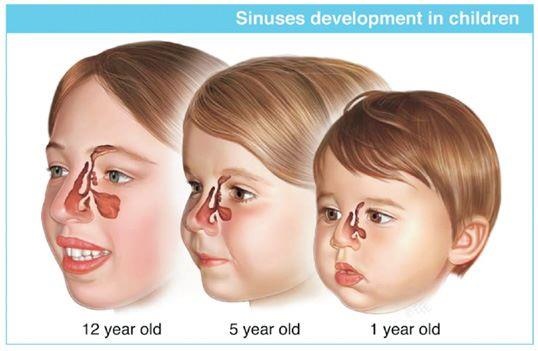
However in children sinuses are still developing and when we refer to sinuses in children;it is mainly maxillary and ethmoids.


Nasal polyps in children can be inflamatory (bacterial),allergic or associated with cystic fibrosis. 

The nasal polyps are of two kinds mainly : Antrochoanal or Sinonasal.

Antrochoanal are ususally single polyps aising from the maxillay antrum and going towards the choana (posterior opening of nostrils).They are usually one sided.

Sinonasal usually arise from the sinus lining of both sides of sinuses.


The common symptoms of polyps are 
nasal block
obstructive sleep apnoea or snoring in children
sometimes nose bleed

Usually the ENT surgeon will ask for CT scan to know the extend of disease.

The nasal polyps require surgical removal.Nowadays in children it is usually endoscopic approach.Sometimes transoral and other approaches are require for complete removal.

As a surgeon,I always consider the growing anatomy of sinuses,unerupted teeth and concern for facial growth in children while deciding the surgery.


Sinusitis in children

Sinusitis is the inflammation of the sinuses.Though an adult has four pairs of sinuses,in children it is usually the maxillary and ethmoid sinuses are involved as the sphenoid and frontal sinuses are still developing.


In children,common cold or viral infection is the commonest cause of sinusitis.
Other common cause is foreign body in the nostrils or untreated allergic rhinitis leading to sinusitis.

Common symptoms the child will have are
Nasal discharge: green or yellow
fever
cough
headache
facial pain or pressure over face
swelling or redness over face or cheeks
swelling around the eyes

Child should be immediately seen by their physician who will decide the treatment starting from decongestion of the nose to allergy treatment or antibiotics depending on diagnosis.
Ocassionally scans are ordered:CT scan of sinuses especially if eye is involved.

Thursday, 1 December 2016

Meditation: A state of mind

Often people think meditation means sitting quiet,closing the eyes and breathing- this activity is prānāyāmā.
No ,meditation is a state of mind,not sitting alone in a room.
Real meditation is in day to day life,in normal existing condition.Meditation is a mental state,You have a problem,you meditate.Take a wholesome view,this is the problem,these are the consequences,keep an ideal before-what is to be done.Hold on to the ideal,examine,do the right thing,say the right thing.
Unfortunately,we are traditionally brought up- as if prayer means to sit before a shrine.
No, prayer is an attitude of mind, a prayerful attitude.

Meditate wherever you are,whatever you may be doing,with a prayerful attitude.

Above is taken from "Raja Yoga Lectures by Swami Sarvagatananda"


Wednesday, 30 November 2016

Is Yoga a way of life or an exercise as publicized?

As majority of humans who are engrossed in their fields and usually blindly believe religious stuff   around,I thought Yoga was some kind of exercise.
It had to be easy since everyone is doing it.I see all these Baba's demonstrating on television or filmstars coming out with videos of yoga.
Anyway I had no time for it (so did I think)  or the right time had to come.
Now I am aware of my ignorance and my miseries lead me to realisation,I am ready to know "What is Yoga?"

Let me tell you I have just made a beginning but so impatient to share with all!just shows I have a long way to go!
We are confusing Yoga with Asana.
For those who are spiritually inclined,Patanjali lists eight steps-

  • Yama,niyama deals with moral excellence
  • asana,pranayama deals with the physical  
  • Pratyahara,dharana deals with mental
  • dyana,samadhi deals with spiritual
So even before we reach physical i.e. asanas ,we need to be morally sound.

Yoga is not something which if attained will lead us to Heaven,it teaches us how to cope and live now..here.


Sharing some excerpts from Books and Lectures of Swami Vivekananda.
"Yoga means Union.Yoga is purposeful living.
Following are the unities you gain from yoga 1. First is within yourself 2. Is within the society and 3. By gradually evolving you gain the Ground.
Yoga touches the mainstream of our life,our way of thinking,feeling and functioning.We need Yoga in our day to day living."
Yoga does not take us beyond this life and existence,
It helps us to conduct ourselves properly in day to day life.
It is not for post-mortem bliss or something somewhere in heaven.

Yoga is purposeful living and realising.Knowing the pain but not being miserable.knowing the facts.

Reflect not react!
Oh!with all the past memories in my subconscious and the samskaras ingrained,it's not an easy task.
How do we resolve the subconscious mental contents (Samakaras) ?
Either we have a strong mind or strong will to be absolutely unaffected- Buddha Method or we Surrender completely to the divine like a child runs towards its mother for protection.
There are 3 things necessary for the practice of yoga -
1.Austerity,self control
2.Knowledge, study, ability to think
3.Surrendering to the divine. As Jung said "God is a psychological necessity ".

We are ignorant,lost,helpless and confused; And then there is nobody to blame -no society,no parents or environment.For we are humans and have a chance to correct our ignorance.
It is never too late ,No case is hopeless "


An introduction on Yoga from Complete Works of Swami Vivekananda Volume VI  is worth a read.

And really do not get caught in so called Power Yoga,popularised by the west.
I personally believe,we Indians should claim the right on the use of the word Yoga in the right sense.
It is the duty of each one of us to stand for our precious teachings and culture.

Wednesday, 9 November 2016

Dare to be Deaf!

Vertigo in Children

Vertigo in children is uncommon.The attacks of vertigo in children may be less dramatic than adults,however they cause severe anxiety if a diagnosis is not reached and appropriately explained.

The clinical diagnosis involves accurate history which many adults are not capable of giving.The reason I say so is that the terms "Vertigo" "Dizziness""Giddiness" and "Imbalance" are very commonly used without proper understanding by adult patients,let alone poor child!
When a child presents with vertigo, we also need to keep in mind their distractibility,coordination capabilities and behavioral problems.Also the compliance in pediatric population to perform otoneurological examinations is limited

Let us go through various terms commonly used by patients or parents.
Dizziness can be used to explain different sensations like lightheadedness, Fainting or Syncope, Giddiness (when engaging in activities like spinning) or Vertigo.

Vertigo is a sensation of spinning (either we feel spinning or the surrounding is spinning).It can be associated with nausea,jerky eye movements,headache,sweating and ringing in the ears or hearing loss.

Vertigo is an uncommon complaint in children and adolescents.Despite the most significant technological achievements in the development of diagnostic tools like scans and audiology, diagnosis is still based mainly upon the patient’s history and physical examination.There could be history of migraine or vertigo in the family.

The child's pediatrician may refer to Pediatric ENT for further otologic and audiologic evaluation.If required, the child may be seen by neurologist for evaluation.

There have been various scientific studies about the etiologies or causes of vertigo in children.The common causes of vertigo or the differential diagnosis includes Migraine associated vertigo or variants,Benign Paroxysmal Vertigo, Otitis Media and rarely other inner ear pathologies.


It is worth mentioning about "Motion Sickness" here.
It is a clinical phenomenon provoked by passive locomotion or movement of the visual environment only.It consists of pallor,tiredness,weakness,hypersalivation,nausea and emesis.

Diagnosis should be followed by adequate symptomatic treatment and management of underlying etiologies.The success of treatment of vertigo lies in regular follow up.

Tuesday, 2 August 2016

Noisy breathing in infants and children

 A newborn breathes more rapidly than an adult. This is due to the fact that lung capacity of a baby is less than adult. So to hold oxygen they need to breath in and out more often.This is the reason why babies and young children have higher respiratory rate than adults.  

Some children present with abnormal sound during breathing. There are two common types of noisy breathing -Snoring and Stridor.

Snoring in children is a sound due to upper airway obstruction. The commonest cause of snoring in children is enlargement of adenoids and tonsils referred to as Adenotonsillar Hypertrophy.


The degree of adenotonsillar hypertrophy is assessed with clinical examination. In some children this can lead to disturbed sleep and daytime hyperactivity. This is referred to as Obstructive Sleep Apnoea. Your child’s paediatrician will send to an ENT surgeon to confirm the diagnosis. Adenotonsillectomy surgery is the solution for obstructive sleep apnoea in children.

Stridor is a sound produced by turbulent airflow through a partially obstructed airway. There can be various types of stridor depending on the location and severity of airway narrowing. There can be acute causes of stridor like airway inflammation or infections. These are medically managed by Paediatricians.
The most common non acute cause of stridor in infants and children is Laryngomalacia. 


In laryngomalacia, cartilages of upper larynx collapse inwards during taking breath in.This leads to obstruction.
Laryngomalacia is the commonest congenital laryngeal anomaly followed by vocal cord paralysis and subglottic stenosis. This is generally a self-limiting disease but when severe it may cause airway obstruction, feeding difficulty and failure to thrive.

In most cases of noisy breathers, your child’s Pediatrician will decide whether an ENT opinion is required. A visit to ENT clinic will consist of consultation with otolaryngologist who will decide whether direct visualisation of your child’s airway is required.


Flexible fiber-optic laryngoscopy examination is performed as an out patient procedure in most of the children. It allows excellent visualisation of upper airway structures.


Trust real doctors sitting in front of you, not internet....

  On Doctors day 1st July 2022, we can only wish for a healthy life and relationship for both patients and doctor. The first practical class...